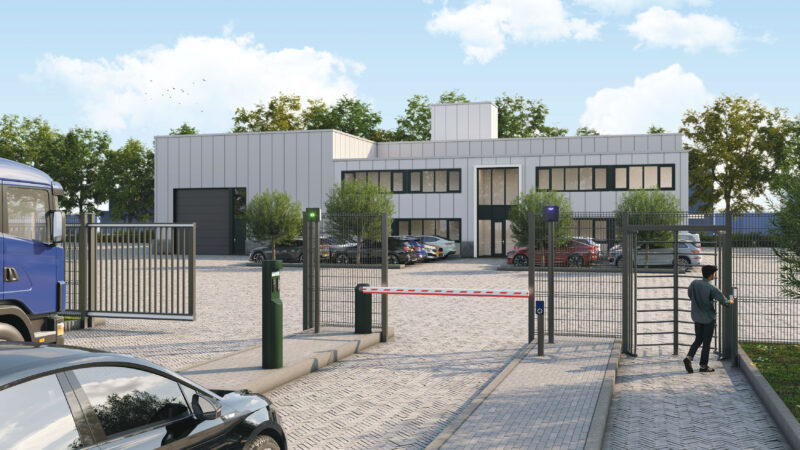
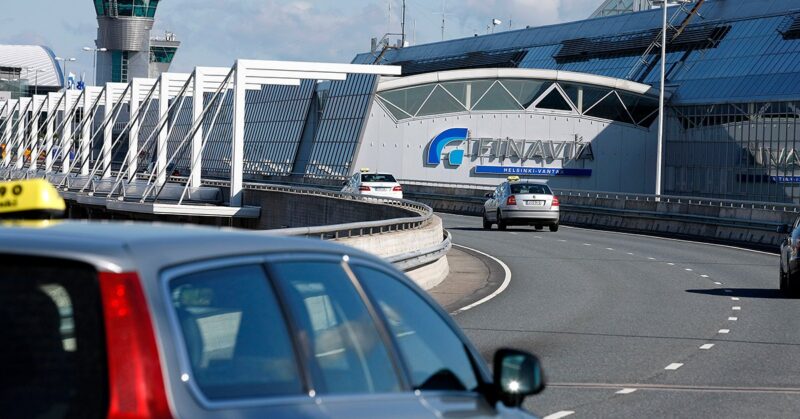
Four things about a gate decide which vehicle identification technology will work there: the number of lanes, the clear width of the opening, the mix of vehicle heights that pass through it and the conditions the reader has to survive. Get one of them wrong and you end up with a barrier that opens for the wrong lane, a truck driver leaning out of a cab in the rain or a reader that gives up after its first winter.
What makes a perimeter gate difficult
A gate layout is never a free choice. It follows the site: the space available, the direction of the traffic flow, the vehicles that need to get in and the security level the site has to meet. Identification technology has to fit that layout, not the other way around. So before comparing readers, map your own gate against the four situations below. Most sites recognise at least two, and a busy industrial site usually recognises all four.
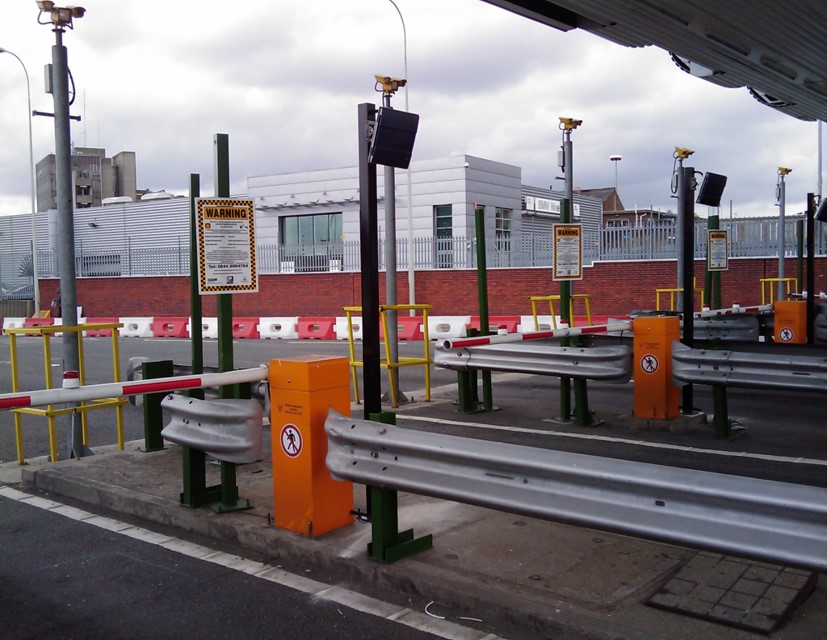
Multi-lane gates
Multiple lanes keep peak-hour traffic moving. They also create the most common failure in vehicle access control: the reader picks up a tag in the lane next to the one the vehicle is actually in. The barrier opens for the wrong vehicle, and the access log stops matching reality.
So the reader needs a read range you can limit per lane and a beam narrow enough to stop at the lane divider. One that simply reads as far as its hardware allows is a liability here, not a feature. Optimising the traffic flow starts with keeping the lanes apart electronically.
Mixed vehicle heights in one lane
When cars, vans and trucks share a lane, the driver’s eye level moves by two metres or more from one vehicle to the next, and short range identification at a pedestal breaks down. A car driver has to stretch down, a truck driver has to climb halfway out of the cab, and both have to position the vehicle within centimetres of the reader. In practice mirrors get clipped and pedestals get hit.
Long range identification removes the problem, but only if a single reader covers the full height range. Two pedestals at two heights is a workaround, and it doubles what you maintain. It is the same problem as identifying different users quickly and easily, seen from the vehicle side.
Gates wider than 3.5 metres
Trucks and trailers need room to swing. Sites that receive them build gates well over 3.5 metres of clear width, and a driver taking a tight turn will not stay in the middle of that opening. The vehicle can pass a metre off centre, and the tag goes with it.
The reader therefore has to cover the whole width rather than a line down the middle. If it does not, you fit a second reader per lane or you accept that a share of your vehicles will stop for a manual check.
Dirt, moisture and other harsh conditions
At a steel plant, a quarry, a port or a waste facility the gate sits in dust, spray, mud and salt. Two things follow. The driver should not have to open a window, which rules out anything presented by hand. And the reader has to keep working through grime, rain and snow, across the full temperature swing of the year.
Technology choice is a maintenance question here as much as a security one. A reader that needs cleaning every week is a recurring cost, and every minute a vehicle waits is a minute of delay at the entrance.
Which reader fits which gate
Nedap builds a range of automatic vehicle identification readers, and the longest read range is not automatically the right answer. The table maps each situation to what the technology has to do and to the reader that normally fits.
| Gate situation | What the reader has to do | Usual fit |
|---|---|---|
| Multi-lane, high security | Limit the read range per lane, keep the beam narrow across lanes | TRANSIT Ultimate |
| Mixed vehicle heights, one lane | Cover car to truck height from one device | TRANSIT Ultimate or uPASS Target |
| Opening wider than 3.5 metres | Cover the full width from a single position | TRANSIT Ultimate |
| Dust, mud, rain and snow | Read at range through grime, sealed housing, nothing presented by hand | TRANSIT Ultimate |
| Single lane, ordinary conditions, cost led | Steady identification at shorter range, no battery in the tag | uPASS Go |
| Driver and vehicle both verified | Read the vehicle tag and the driver credential together | TRANSIT Ultimate with a Booster |
Not sure which row your gate falls into? The product advisor asks a handful of questions about your site and narrows the portfolio down for you.
How the TRANSIT Ultimate handles these gates
The TRANSIT Ultimate uses semi-active RFID at 2.45 GHz. The tag carries its own battery, which keeps identification steady at long range and at speeds up to 200 km/h without the driver doing anything. Four properties matter here.
Read range you set per lane
The read range is adjustable, so it can be tuned per lane instead of reaching as far as the hardware allows. How far it reaches depends on the tag: the datasheet states up to 15 metres (50 feet) with the Compact Button and up to 20 metres (66 feet) with the Heavy Duty Tag ISO. Many gates are deliberately tuned to around 10 metres, because a tighter read zone is exactly what separates one lane from the next.
One reader for cars, vans and trucks
Because identification happens at range instead of at a pedestal, vehicle height stops being a variable. One reader per lane covers cars, vans and trucks alike, and nothing has to be held up to anything. That removes the second pedestal, and with it the object trucks keep hitting.
Vertical or horizontal mounting
The reader has a wide beam of 80 degrees in one plane and a narrow beam of 40 degrees in the other, so how you mount it decides what it does. Horizontally, the wide beam covers the full width of a large gate from one position. Turned vertically, the narrow 40 degree beam faces across the lanes, which is what the installation guide recommends to prevent cross readings between driving lanes. The same reader therefore answers the wide gate problem and the multi-lane problem, depending on how you hang it.
Reading through dirt, moisture and snow
The housing is rated IP66 (NEMA4x) and the reader runs from -30 to +66 degrees Celsius (-22 to +150 Fahrenheit). Because the tag transmits on its own battery, a film of dust, rain or snow does not stop identification the way it would with a technology that needs a clear view of the vehicle. It is why the system holds up at steel plants and mining sites.
When another technology fits your gate better
Semi-active RFID is not the answer everywhere, and pretending otherwise costs money. Passive UHF, in the uPASS range, needs no battery in the tag and costs less per vehicle. For a single lane gate in ordinary conditions with a large vehicle population, that is often the better economic choice.
Licence plate recognition identifies any vehicle without fitting a tag at all, which makes it useful for visitors and as a second factor alongside RFID, though it needs a readable plate and a clear line of sight. Our comparison of long-range RFID and ANPR sets out where each one wins.
And if your question is not which vehicle but who is driving it, a vehicle tag will never answer it. A Booster reads the driver’s credential inside the cab and combines it with the vehicle identity, so access depends on both.
Proof from a gate that sees 15,000 vehicles a day
Thyssenkrupp Steel secures seven plant gates with 16 TRANSIT Ultimate readers and 15,000 Compact Tags fitted to vehicles. Around 2,000 trucks and 13,000 cars pass through every day, in the dust and heat of a working steel plant, and they are identified at 10 metres without anyone opening a window. Mixed heights, multiple lanes and harsh conditions at once, at a scale where getting it wrong would back traffic up onto the public road.
“Working with Nedap has given us a reliable and competent partner for over 15 years,” says Ingo Kucharzewski, engineer at thyssenkrupp Steel. Read the full thyssenkrupp Steel story.
Frequently asked questions
The questions we get most often from security managers and integrators planning a gate.
What is the read range of the TRANSIT Ultimate?
Up to 15 metres (50 feet) with the Compact Button and up to 20 metres (66 feet) with the Heavy Duty Tag ISO. Actual range depends on the tag, the mounting position and the environment, and many gates are tuned to around 10 metres for a tighter read zone.
Can one reader cover a gate wider than 3.5 metres?
Yes. Mounted horizontally the reader has an 80 degree beam, which covers a wide opening from one position. One reader per lane is normally enough, even for trailers swinging through off centre.
How do you prevent cross reading between lanes?
Two settings do the work: reduce the read range so it stops short of the neighbouring lane, and mount the reader vertically so the narrow 40 degree beam faces across the lanes. The installation guide recommends that vertical position specifically for multi-lane sites.
Does RFID keep working in rain, snow and dirt?
Yes. The reader is rated IP66 and runs from -30 to +66 degrees Celsius. The tag transmits on its own battery, so identification does not depend on a clean surface or a clear optical view. It is why the system is used at steel plants and mining sites.
How long does a vehicle tag last?
The Compact Button has a replaceable battery with an 8 year lifespan. Because you swap the battery rather than the whole tag, keeping a large vehicle population identified stays affordable over the life of the system.
Have your gate layout reviewed
Send us your gate drawing and the vehicle types that use it, and a product specialist will tell you which reader suits it and where to mount it. You can also download the TRANSIT Ultimate datasheet, browse our solutions and technologies, or contact us with the gate that is giving you trouble.