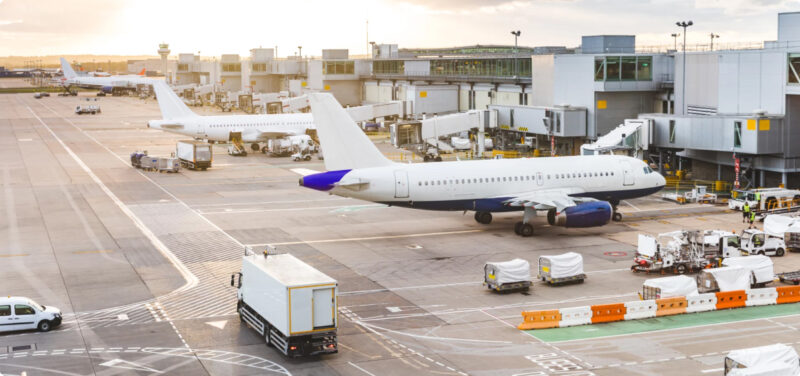
Airports operate in one of the most demanding environments in the world. Around the clock, security, continuity and experience must come together seamlessly, leaving no margin for error. Behind the scenes, this requires smart decisions and solutions that protect critical infrastructure while keeping operations moving. One of the most critical operational control points in this process is vehicle access, directly impacting both safety and the smooth flow of airside operations.
The world of airports
Airports have evolved into complex ecosystems where security, safety, operational efficiency and passenger experience must coexist every minute of the day. While much attention is placed on terminal operations, vehicle access control has become one of the most critical elements of modern airport security.
From early morning onwards, the airport is already in full motion. Fuel trucks, buses, maintenance vehicles and contractors, each with different access rights, risk profiles and time constraints, move through the same network of gates. Every vehicle movement represents a trade-off: slow down and operations suffer; move too fast and security is compromised. For airport security managers, the challenge is clear: how to maintain control over vehicle access without disrupting the flow.
A changing reality at airport gates
Vehicle flows at airports are no longer predictable. Passenger growth, increased outsourcing, tighter aviation regulations and evolving service models have led to higher vehicle volumes, more user types and more access exceptions. As a result, vehicle access has moved from an operational detail to a strategic control point that directly affects compliance, safety and the passenger journey.
Key challenges in airport vehicle access
Airports face a unique and demanding set of vehicle access challenges, driven by diverse user groups, strict regulations and constant operational pressure.
1. Land- and airside access control
Transitions between landside and airside require strict verification. At these points, both the vehicle and the driver must be identified and authorized. Traditional checks provide assurance but introduce delays, making it difficult to maintain security without disrupting operations.
2. Public parking zones
Passenger parking sets the first impression of the airport. Access must be fast, intuitive and secure, yet many parking environments still rely on outdated methods that require drivers to stop, scan tickets or reach for cards leading to queues, congestion and frustration.
3. Bus and taxi lanes
Bus and taxi routes are high-throughput environments where even small delays quickly cascade across terminals. These areas demand fast, automated access for authorized vehicles to keep traffic moving safely and predictably.
4. Contractor and staff access
Airports host a constantly changing mix of employees, contractors and temporary staff, each with different access rights. Manual or legacy access methods are difficult to manage at scale, prone to errors and slow to adapt to changing roles or temporary access needs.
5. Unreliable vehicle recognition
Inconsistent vehicle recognition remains a key challenge. Poor reader placement, unclear driving routes or shared vehicles can result in misreads, triggering manual checks and unnecessary delays, especially at critical access points.
The core challenge for airports is balancing speed, safety, and security under some of the most demanding regulatory conditions of any industry. Successful airports address this by treating vehicle access as a strategic control point integrating identification, authorization, and auditability rather than relying on standalone gates or manual intervention.
Applying identification technologies in airport vehicle access
The most effective airports treat vehicle access not as a collection of gates, but as a dynamic ecosystem. They apply identification technologies based on risk, throughput and user profile. This portfolio approach combines strong security at critical points with frictionless flow where speed and convenience are essential.
1. Critical land-to-airside transitions
Land-to-airside access points require the highest level of security. Semi-active RFID technology, such as Nedap’s TRANSIT Ultimate in combination with Nedap’s Booster, enables long-range identification of both the vehicle and the driver (up to 12 meters) while vehicles remain in motion. This ensures fast, secure access at sensitive points without stopping traffic, even under high pressure and peak volumes.
2. Permanent airside fleets and ground handling vehicles
Airside service vehicles and ground handling fleets operate continuously and under demanding conditions. Nedap’s TRANSIT Ultimate provides reliable long-range RFID identification at speed, in poor weather and during heavy traffic. By ensuring consistent identification, it reduces tailgating, limits manual checks and supports safe, uninterrupted airside operations.
3. Public parking and temporary vehicle access
Public parking areas and short-term vehicle access require a frictionless experience. Nedap’s ANPR Lumo uses automatic license plate recognition to enable fast, hands-free access for travellers, visitors and temporary contractors without the need for cards or tags. Access rights can be issued or revoked instantly, making it ideal for short-stay, one-time or subscription-based parking scenarios.
4. Bus lanes, taxi lanes and staff parking
High-throughput areas such as bus and taxi lanes depend on continuous flow and accurate vehicle recognition. Nedap’s uPASS Target and uPASS Go use UHF RFID technology with passive tags to deliver reliable, hands-free identification at distances of up to 15 meters. This supports high vehicle volumes with minimal maintenance and consistent performance.
5. Visitors, contractors and staff entry points
Access points for staff, visitors and contractors demand flexibility. NVITE acts as a multi-technology platform supporting mobile credentials, QR codes, RFID, smartcards and proximity cards. When combined with ANPR Lumo, vehicles and drivers can be registered, controlled and audited efficiently supporting both temporary and permanent access needs.
Key insights for airport security managers
By applying the right access solution to each zone, airports can optimize vehicle movement across the site, reducing security risks, minimizing delays at critical checkpoints and tailoring identification to each user group. The most resilient airports treat vehicle access control as a strategic capability, combining identification technologies in a layered, risk-based approach to strengthen security while maintaining high throughput. Although vehicle access sits outside the terminal, its impact is felt throughout airport operations—from aircraft turnaround to passenger perception.

Frequently asked questions about airports
How do airports identify vehicle access without delays?
Modern airports use long-range RFID and ANPR systems that identify both driver and vehicle while in motion, eliminating the need for full stops at checkpoints.
What technologies improve airport access control?
Airports apply different technologies depending on each zone’s purpose and security level. Common combinations include semi-active RFID, mobile credentials, and license plate recognition, together forming an integrated approach that keeps both safety and efficiency in balance.
How can airports ensure compliance with aviation security standards?
Layered access control with digital authorization logs supports both operational efficiency and traceability, meeting international security requirements.
Secure vehicle access without slowing operations
Discover how Nedap helps airports secure vehicle access without slowing operations. Speak with an expert to assess your current setup and explore how layered access technology can future-proof your airside and landside operations.


